Automotive Interior Market

Automotive Interior Market by Component (HUD, Door Panel, Dome Module, Seat, Headliner, Center Console, Center Stack), Material Type, Level of Autonomy, Electric Vehicle, Passenger Car Class, ICE Vehicle Type, and Region - Global Forecast to 2033




OVERVIEW
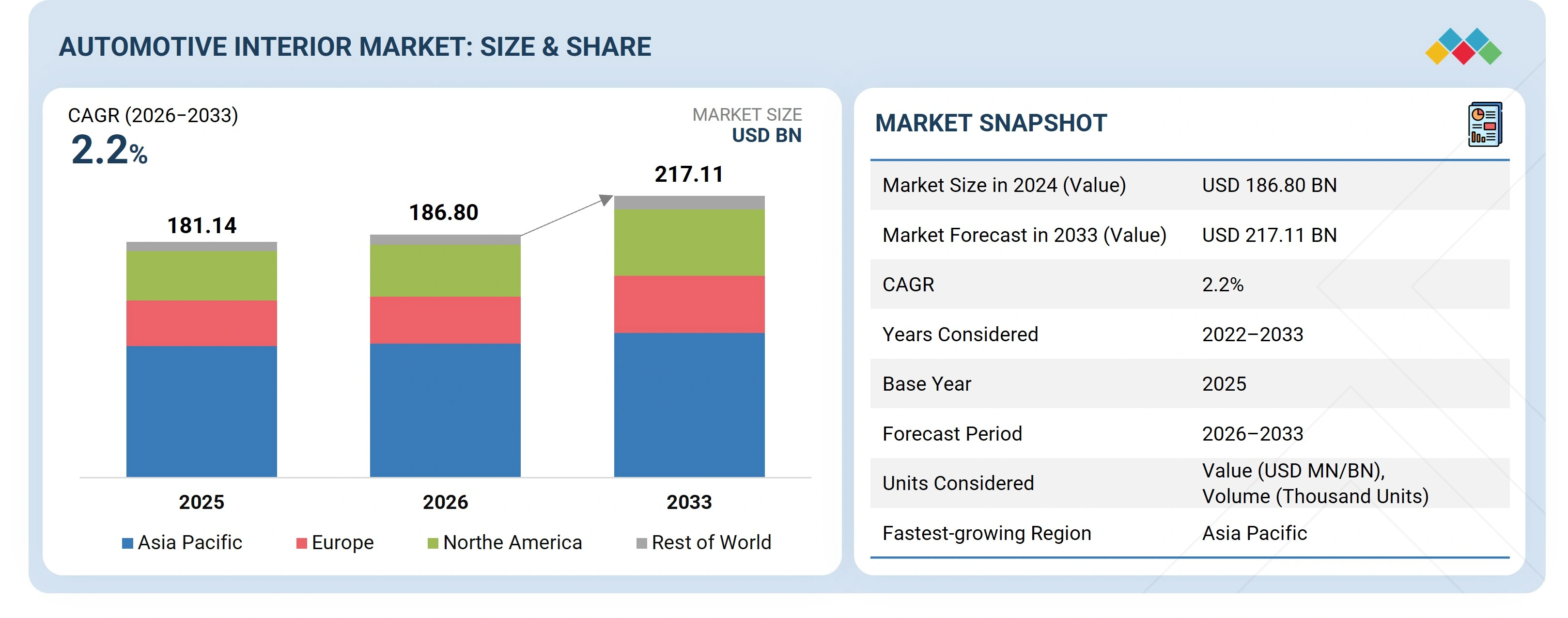
Source: Secondary Research, Interviews with Experts, MarketsandMarkets Analysis
The Automotive Interior market is projected to grow from USD 186.80 billion in 2026 to USD 217.11 billion by 2033, at a CAGR of 2.2% during the forecast period. The EV segment of the global automotive interior market was valued at USD 83.4 million in 2026 and is projected to reach USD 173.6 million by 2033, growing at a CAGR of 11.1% from 2026 to 2033. Asia Pacific remains the dominant market, supported by strong vehicle production, expanding EV manufacturing, and rapid adoption of software-defined cockpit technologies. Market growth is primarily driven by the increasing integration of AI-enabled infotainment, AR-based HUDs, smart surfaces, and connected cabin ecosystems, as well as rising demand for modular and premium interior architectures in EVs and next-generation mobility platforms. However, the market continues to face challenges related to the complexity of integrating electronically intensive cabin systems, semiconductor dependence, and the need to balance advanced in-cabin experiences with cost efficiency and platform scalability.
Automotive Interior Market Size and Forecast:
- Market Size Value in 2026: USD 186.80 Billion
- Revenue Forecast in 2033: USD 217.11 Billion
- Growth Rate: CAGR of 2.2% from 2026 to 2033
- Data available from 2022 to 2033
- Base year: 2025
- Forecast period: 2026–2033
- Largest Growing Region: Asia Pacific
- Units Considered: Value (USD Billion), Volume (Units)
Key Automotive Interior Market Trends and Insights
- Automotive Interior Market Growth: Growth is driven by increasing vehicle production, rising consumer demand for premium cabin experiences, and growing adoption of advanced interior technologies in passenger vehicles.
-
Technology Impact: Smart cockpit systems, connected infotainment platforms, ambient lighting, digital displays, advanced HMI technologies, and sustainable materials are transforming vehicle interior design and functionality.
- Growing Trends: The Automotive Interior market is witnessing increased adoption of digital cockpits, lightweight interior materials, sustainable upholstery, panoramic displays, AI-powered voice assistants, and customizable in-cabin experiences.
- Growth Opportunities: Opportunities are driven by the growth of electric and autonomous vehicles, increasing demand for premium interiors, advancements in connected vehicle technologies, and rising investments in smart cabin innovations.
KEY TAKEAWAYS
-
Automotive Interior Market, By RegionThe Asia Pacific automotive interior market is estimated to account for the highest revenue share, at>55.3%, in 2026.
-
By Component TypeThe head-up display segment is expected to grow at the fastest rate of 9.4%.
-
By Vehicle TypeThe light commercial vehicles segment is projected to grow at the fastest rate from 2026 to 2033.
-
By Component TypeThe battery electric vehicles segment is expected to have the largest market share and grow at the fastest CAGR.
-
By Eletric VehicleThe rear-seat entertainment segment is expected to be the fastest-growing in EVs over the forecast period.
-
By Material TypeBy Material type, the PVC/ Thermoplastics segment is expected to grow at the fastest CAGR.
-
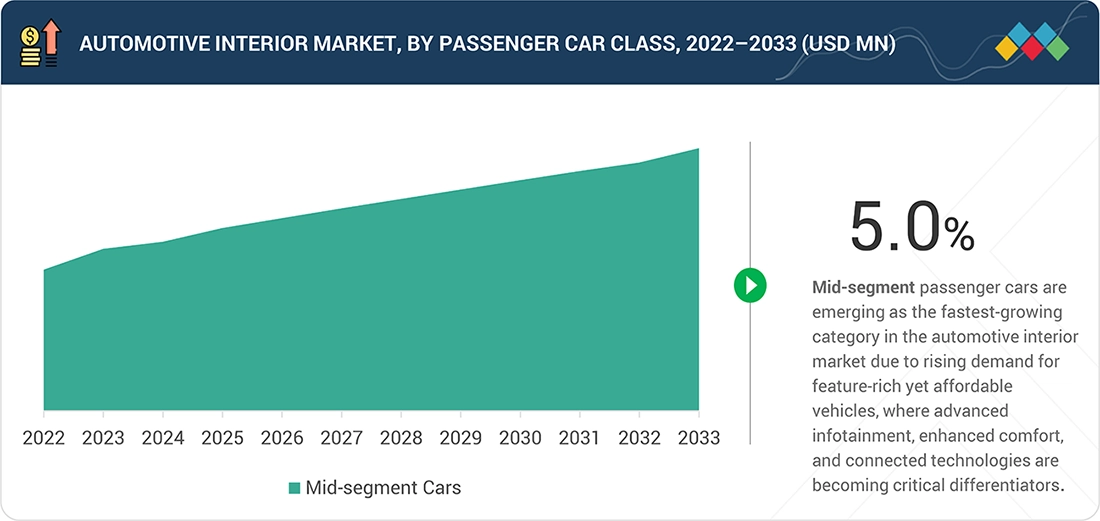
By Passenger Cars ClassThe mid-segment cars are expected to be the fastest-growing market for automotive interiors.
The automotive interior market is growing steadily as automakers focus on enhancing the in-cabin experience, digital integration, and differentiation, while consumers are demanding connected, comfortable, and personalized interiors. OEMs are integrating software-defined cockpits and advanced infotainment systems, while leveraging connectivity and data to improve user experience, safety, and lifecycle value. Electrification is accelerating interior transformation, enabling spacious cabin layouts, digital-first designs, and integrated interfaces, with OEMs partnering with technology players to deliver AI-enabled systems, large displays, and connected features that are reshaping the automotive interior market.
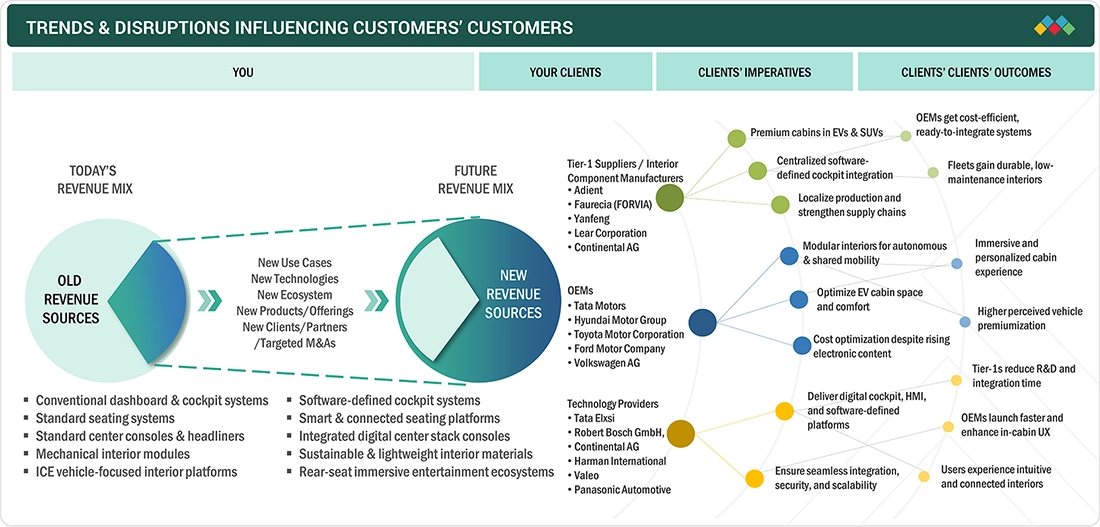
TRENDS & DISRUPTIONS IMPACTING CUSTOMERS' CUSTOMERS
Trends and disruptions in the automotive interior market reveal the current and future trends. The automotive interior market is being shaped by trends such as advanced seating technologies, including powered, heated, ventilated, and memory/massage seats, driven by the growing SUV segment and rising consumer income. Infotainment and display innovations, including smart, curved, and multi-display systems with Android Auto, Apple CarPlay, AR, and 5G connectivity, are transforming in-car experiences.
Source: Secondary Research, Interviews with Experts, MarketsandMarkets Analysis
MARKET DYNAMICS

Level
-
Software-defined cabin evolution

-
EV-driven interior innovation and premiumization of mid-segment vehicles


Level
-
Software-hardware integration bottlenecks

-
Over-the-air (OTA) reliability & cybersecurity risks


Level
-
Development of immersive in-cabin experience technologies

-
Rising demand for reconfigurable and lounge-style interiors


Level
-
Managing seamless integration of multiple digital interfaces

-
Cost-pressure vs. premiumization conflict

Source: Secondary Research, Interviews with Experts, MarketsandMarkets Analysis
Driver:Software-defined cabin evolution
The increasing shift toward software-defined vehicles (SDVs) is transforming interiors into digital ecosystems with centralized computing, large displays, AI-enabled interfaces, and OTA updates, thereby enhancing personalization and enabling continuous feature upgrades.
Restraint: Software-hardware integration bottlenecks
Integration challenges between complex electronics, software platforms, and traditional hardware systems are leading to higher costs, longer development cycles, and increased system compatibility issues for OEMs and suppliers.
Opportunity: Development of immersive in-cabin experience technologies
Growing demand for AR-HUDs, smart surfaces, ambient lighting, voice/gesture controls, and AI-driven infotainment is creating opportunities to deliver interactive, personalized, and experience-centric interiors.
Challenge: Managing seamless integration of multiple digital interfaces
Ensuring smooth interaction between multiple screens, sensors, connectivity systems, and user interfaces while maintaining low latency, cybersecurity, and user-friendly design remains a key challenge for industry players.
AUTOMOTIVE INTERIOR MARKET: COMMERCIAL USE CASES ACROSS INDUSTRIES
| COMPANY | USE CASE DESCRIPTION | BENEFITS |
|---|---|---|
 |
Development of sustainable interior materials and smart cockpit solutions integrating large displays and connected systems | Enhances in-cabin experience, reduces environmental impact, and supports lightweight vehicle design |
 |
Deployment of smart seating systems with integrated sensors, memory functions, and wellness features | Improves passenger comfort, enables personalization, and enhances long-distance driving experience |
 |
Integration of intelligent cockpit systems with digital interfaces, ambient lighting, and modular interior designs | Enables immersive user interaction, improves cabin aesthetics, and supports flexible interior layouts |
 |
Development of connected seating and electrical distribution systems for software-defined interiors | Enhances connectivity, supports real-time data integration, and improves system efficiency |
 |
Deployment of advanced HMI solutions including head-up displays (HUDs), driver monitoring systems, and large curved displays | Improves driver safety, reduces distraction, and delivers real-time information for better decision-making |
Logos and trademarks shown above are the property of their respective owners. Their use here is for informational and illustrative purposes only.
MARKET ECOSYSTEM
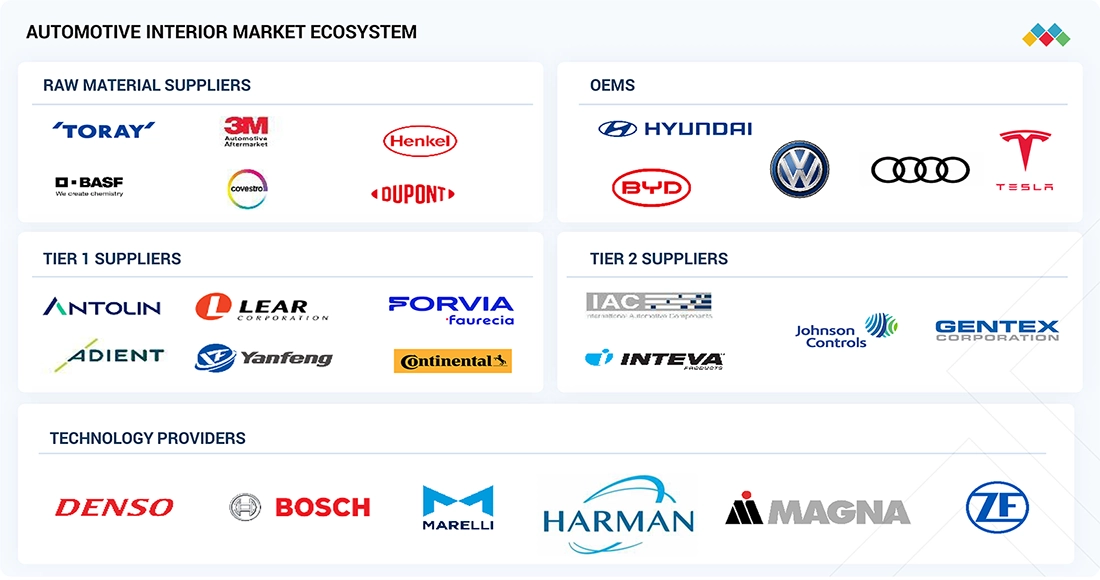
The automotive interior market ecosystem includes OEMs, Tier 1 & Tier 2 suppliers, raw material suppliers, and technology providers. The automotive interior market is dominated by key players such as Lear Corporation (US), Adient plc. (US), Yanfeng (China), FORVIA Faurecia (France), and Continental AG (Germany). These companies have a global distribution network across Asia Pacific, North America, and Europe. They are vital in their domestic markets and are exploring geographic diversification opportunities to grow their businesses.
Logos and trademarks shown above are the property of their respective owners. Their use here is for informational and illustrative purposes only.
MARKET SEGMENTS
Source: Secondary Research, Interviews with Experts, MarketsandMarkets Analysis
Automoive Interior Market, By Component Type
The seat segment is set to dominate the automotive interior market, driven by rising vehicle production and demand for comfort and luxury. Asia Pacific leads in conventional seat adoption, while North America and Europe focus on high-tech, powered, and multi-functional seats. Advanced display systems and safety regulations further support market growth in technologically developed countries.
Automoive Interior Market, Electric Vehicle Type
Battery electric vehicles (BEVs) dominate the market due to their higher integration of electronics and advanced systems. Features such as digital instrument clusters, infotainment, HUDs, and smart interiors drive strong consumer demand, which is expected to grow further during the forecast period.
Automoive Interior Market, ICE Vehicle Type
The passenger car segment is set to lead the automotive interior market, driven by rising consumer purchasing power, luxury vehicle sales, and demand for advanced comfort and convenience features. The adoption of semi-autonomous vehicles with smarter displays and adaptive controls is further boosting market growth.
Automoive Interior Market, Level of Autonomy
Semi-autonomous cars lead the automotive interior market due to the need for advanced cabins with adaptive controls, 360-degree cameras, and multi-functional displays. Features like AR HUDs and personalized seating enhance safety and comfort, while Level 2 and 3 technologies drive demand for high-tech interior components.
Automoive Interior Market, By Material Type
The PVC/thermoplastics segment is expected to grow at the fastest CAGR in automotive interior market due to its lightweight properties, design flexibility, and cost efficiency, along with compatibility with advanced features such as soft-touch surfaces, integrated controls, and modular components. These advantages enable OEMs to enhance cabin aesthetics and functionality while optimizing production costs, driving strong demand.
Automoive Interior Market, By Passenger Car Class
Economic cars are expected to lead the market during the forecast period, offering affordable access to features such as basic infotainment, Bluetooth, and driver-assistance systems. OEMs are enhancing interiors with cost-effective materials, while luxury vehicles continue to offer advanced, lightweight, and high-tech components for comfort and performance.
REGION
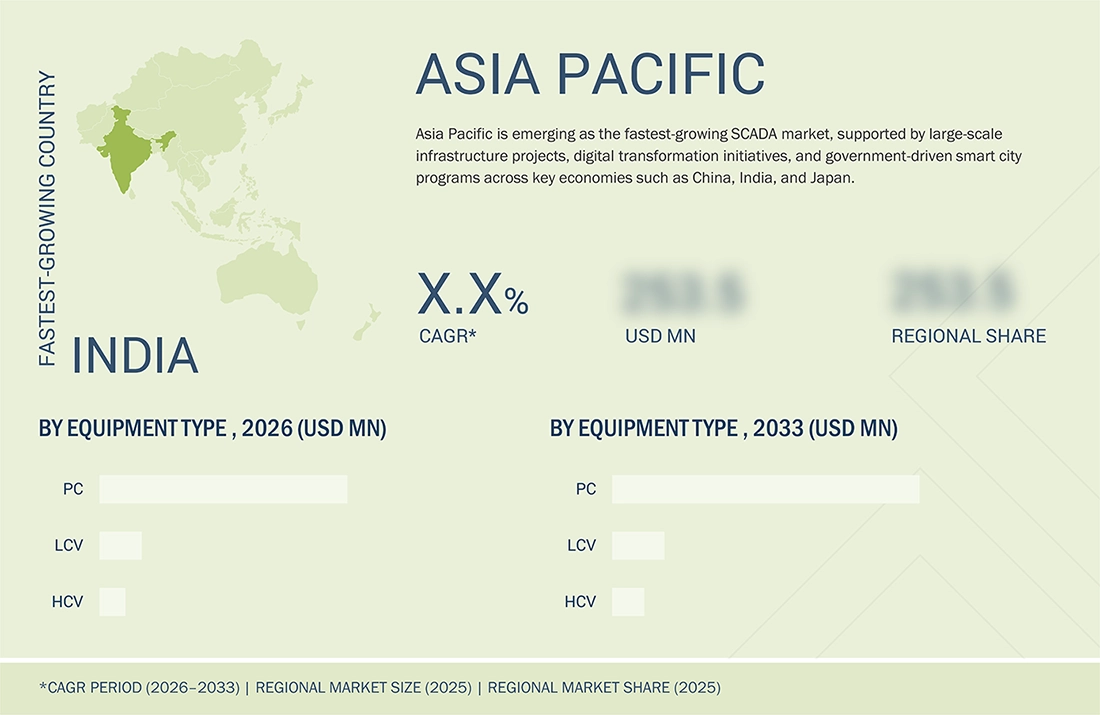
Asia is projected to be the fastest-growing automotive interior market during the forecast period
The Asia Pacific automotive interior market is the largest globally, driven by high vehicle production, rapid urbanization, and strong demand for passenger cars, particularly in China and India. The region benefits from growing adoption of electric vehicles and connected technologies, increasing the need for advanced interior components such as digital cockpits, smart seating, and infotainment systems. OEMs and suppliers in the region are focusing on localized manufacturing, cost-efficient solutions, and integration of advanced electronics, while investing in sustainable materials and software-defined interiors. Rising demand for feature-rich mid-segment vehicles and premium interior experiences is further accelerating market growth across the region.
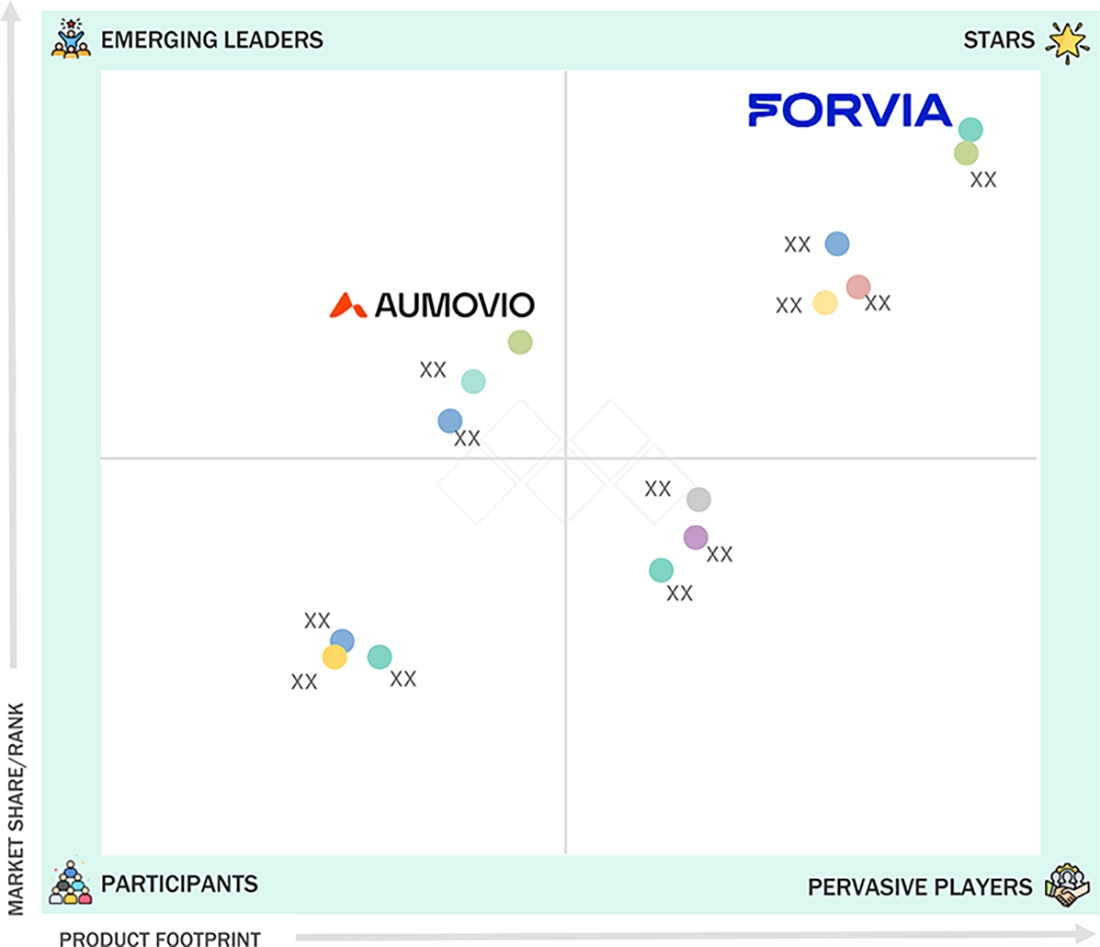
AUTOMOTIVE INTERIOR MARKET: COMPANY EVALUATION MATRIX
In the automotive interior market matrix, Forvia (Star) leads with a strong global presence and comprehensive automotive interior offerings, driving market expansion and revenue growth through innovative seating solutions, advanced electronics integration, and a diverse portfolio of premium and mid-segment interior components. Aumovio (Emerging Leader) is gaining traction with customized interiors, advanced electronics, and lightweight, sustainable materials for premium vehicles. The company shows strong growth potential to advance toward the leaders' quadrant.
Source: Secondary Research, Interviews with Experts, MarketsandMarkets Analysis
KEY MARKET PLAYERS
- Lear Corporation (US)
- FORVIA Faurecia (France)
- Adient plc. (US)
- Continental AG (Germany)
- Yanfeng (China)
- Antolin (Spain)
- SAMVARDHANA MOTHERSON GROUP (India)
- Toyota Boshoku Corporation (Japan)
- Robert Bosch GmbH (Germany)
- Hyundai Mobis (South Korea)
- Denso Corporation (Japan)
- ZF Friedrichshafen AG (Germany)
- Panasonic Automotive Systems Co., Ltd. (Japan)
- DRÄXLMAIER Group (Germany)
MARKET SCOPE
| REPORT METRIC | DETAILS |
|---|---|
| Market Size in 2025 (Value) | USD 181.14 Billion |
| Market Size in 2033 (Value) | USD 217.11 Billion |
| Growth Rate | CAGR of 2.2% from 2026 to 2033 |
| Actual Data | 2022–2033 |
| Base Year | 2025 |
| Forecast Period | 2026-2033 |
| Units Considered | Volume (Thousand Units) and Value (USD Million/Billion) |
| Report Coverage | Revenue forecast, company ranking, competitive landscape, growth factors, and trends |
| Segments Covered |
|
| Regional Scope | Asia Pacific, Europe, North America, and the Rest of the World |
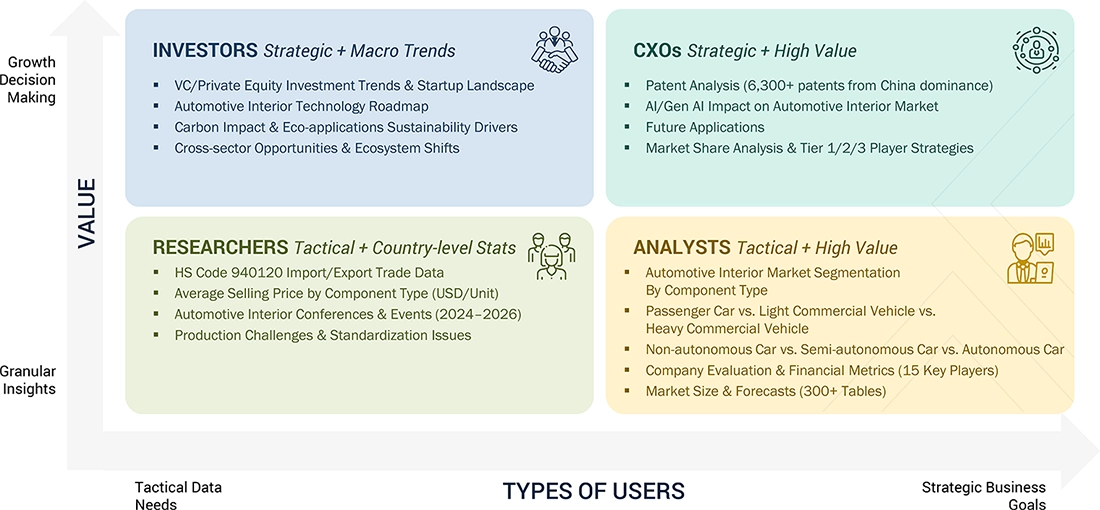
WHAT IS IN IT FOR YOU: AUTOMOTIVE INTERIOR MARKET REPORT CONTENT GUIDE
DELIVERED CUSTOMIZATIONS
We have successfully delivered the following deep-dive customizations:
| CLIENT REQUEST | CUSTOMIZATION DELIVERED | VALUE ADDS |
|---|---|---|
| Global Tier-1 Interior Supplier (Germany) | • Competitive benchmarking of Adient, Faurecia, Lear, and Magna in seating systems • Supply chain mapping of foam, trim, and fabric suppliers |
|
| Luxury OEM (Japan) | • Consumer preference analysis for premium interior materials (leather, wood, ambient lighting) • Cost–benefit analysis of sustainable and vegan leather alternatives |
|
| EV Startup (US) | • Interior design trend study for EVs—minimalistic and modular layouts • Benchmarking digital cockpit and display integration practices |
|
| Component Manufacturer (India) | • Market sizing for instrument panels, headliners, and door trims across vehicle segments • Technology roadmap for lightweight and recyclable interior materials |
|
| Infotainment System Supplier (South Korea) | • OEM partnership mapping for infotainment and connected cockpit systems • Competitive intelligence on software integration and voice assistant features |
|
RECENT DEVELOPMENTS
- April 2026 : Mercedes-Benz introduced its next-generation MBUX Superscreen, enhancing digital cockpit capabilities with AI-powered interfaces and immersive display integration to improve in-cabin experience.
- March 2026 : FORVIA Faurecia launched its IGNITE roadmap, focusing on software-defined interiors, smart seating, and advanced cockpit electronics to strengthen its interior solutions portfolio.
- February 2026 : Continental AG expanded its AR-HUD and smart cockpit technologies to enable enhanced driver interaction, safety, and real-time data visualization.
- January 2026 : Lear Corporation advanced its sustainable seating and E-Systems integration, focusing on lightweight, connected interior solutions aligned with EV platforms.
Table of Contents
 Exclusive indicates content/data unique to MarketsandMarkets and not available with any competitors.
Methodology
Exhaustive secondary research was conducted to collect information on the market, the peer market, and the parent market. The data was validated by industry experts across value chains through primary research. The top-down approach was employed to estimate the complete market size. Thereafter, market breakdown and data triangulation were used to estimate the market size of segments and subsegments.
Secondary Research
In the secondary research process, various secondary sources were used to identify and collect information on the automotive interior market for this study. Secondary sources for this research study include corporate filings, such as annual reports, investor presentations, and financial statements; trade, business, and professional associations; whitepapers and automotive software-related journals; certified publications; articles by recognized authors; directories; and databases. Secondary research has been used to obtain key information about the industry's supply chain, the overall pool of key players, market classification and segmentation according to industry trends to the bottom-most level, regional markets, and key developments from the market- and technology-oriented perspectives.
Primary Research
Extensive primary research has been conducted following an understanding of the global automotive interior market through secondary research. Several primary interviews have been conducted with market experts from both the demand (OEMs/vehicle manufacturers) and supply (component manufacturers, module manufacturers, material providers, and system integrators) sides across four major regions, namely, North America, Europe, Asia Pacific, and the Rest of the World. Approximately 22% of the experts involved in primary interviews have been from the demand side, and 78% have been from the supply side of the industry. Primary data has been collected through questionnaires, emails, and telephonic interviews. Several primary interviews have been conducted with departments across organizations, such as sales, operations, and administration, to provide a holistic perspective in the report.
Following interactions with industry participants, brief sessions have been conducted with experienced independent consultants to reinforce the findings from the primary interviews. This, along with the opinions of in-house subject matter experts, has led to the findings outlined in the remainder of this report.
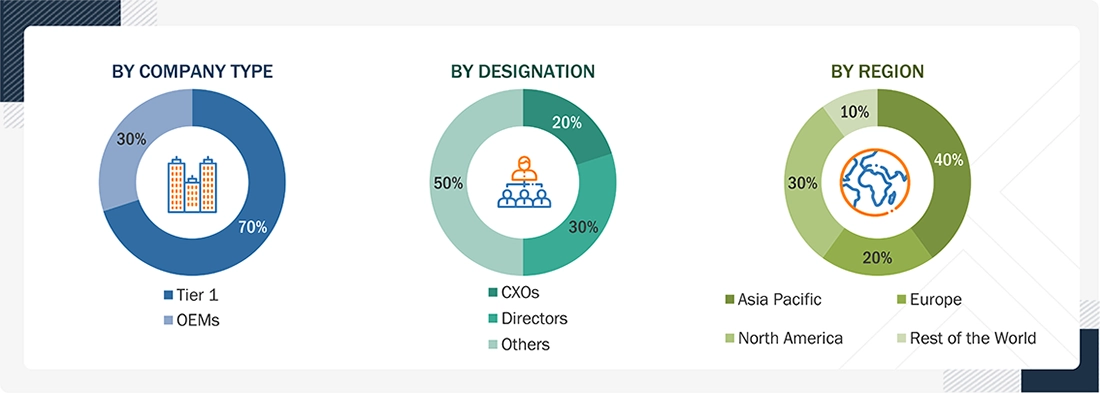
Note: Tiers of companies are based on the value chain of the automotive interior market; revenues of companies have not been considered. Tier 1 companies are component manufacturers. Other designations include sales, marketing, and product managers.
To know about the assumptions considered for the study, download the pdf brochure
Market Size Estimation
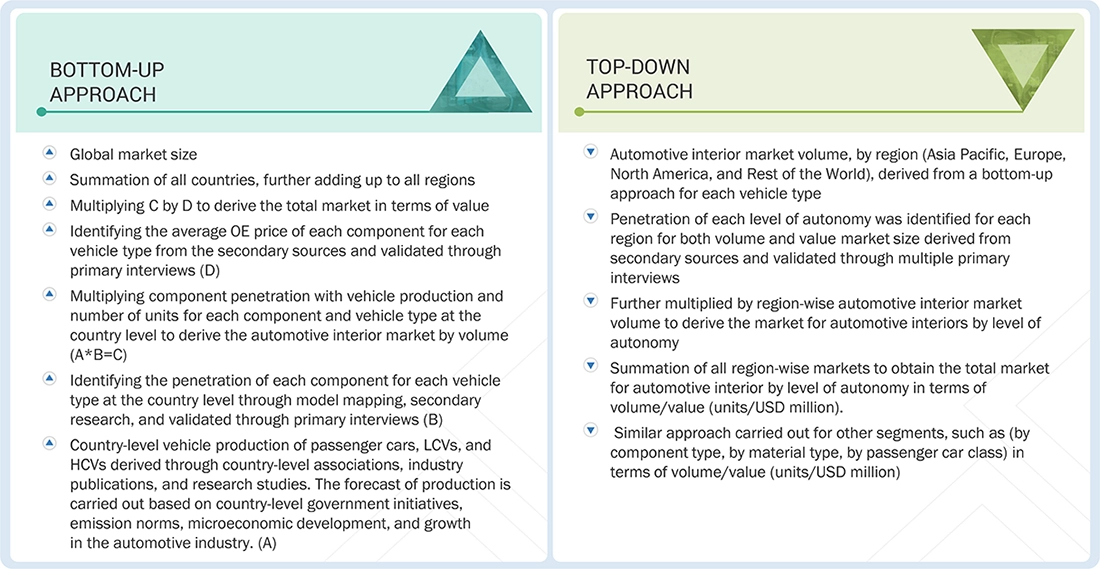
The bottom-up and top-down approaches have been used to estimate and validate the size of the global automotive interior market. In these approaches, vehicle production statistics for each vehicle type (passenger, light commercial, and heavy commercial) in a country have been considered.
A detailed market estimation approach has been followed to estimate and validate the volume and value of the automotive interior market and other dependent submarkets, as mentioned below:
- Key players in the automotive interior market have been identified through secondary research, and their global market shares have been determined through both primary and secondary research.
- The research methodology includes analyzing annual and quarterly financial reports & regulatory filings from major market players, as well as conducting interviews with industry experts to obtain detailed market insights.
- All major penetration rates, percentage shares, splits, and breakdowns for the automotive interior market across different countries and regions have been determined using secondary sources and verified through primary sources.
- All key macro indicators affecting the revenue growth of the market segments and subsegments have been accounted for, viewed in extensive detail, verified through primary research, and analyzed to get the validated and verified quantitative & qualitative data.
- The gathered market data has been consolidated, supplemented with detailed inputs, analyzed, and presented in this report.
Data Triangulation
All percentage shares, splits, and breakdowns have been determined using secondary sources and verified through primary sources. All parameters affecting the markets covered in this research study have been accounted for, viewed in extensive detail, verified through primary research, and analyzed to obtain the final quantitative and qualitative data. This data has been consolidated and enhanced with detailed inputs and analysis from MarketsandMarkets and presented in the report. The following figure illustrates the overall market size estimation process used in this study.
Market Definition
Automotive interiors refer to the interior components of a vehicle's cabin/body, including the center stack, door panels, seats, instrument cluster, lighting, headliner, dome module, center console, and other components.
Key Stakeholders
- Original Equipment Manufacturers (OEMs)
- Tier 1 Component Manufacturers, Tier 2 Raw Material Suppliers
- ADAS/Occupant Safety Solution Suppliers
- Augmented Reality HUD Technology Providers
- Automobile Organizations/Associations
- Automotive Center Stack Manufacturers
- Automotive Cockpit Manufacturers
- Automotive Component Manufacturers
- Automotive Display Suppliers
- Automotive Electronic Hardware Suppliers
- Automotive Electronic System Integrators
- Automotive Instrument Cluster Manufacturers
- Automotive Interior System Manufacturers
- Automotive Seats Manufacturers
- Automotive Smart Display Panel Manufacturers
- Automotive SoC and ECU Manufacturers
- Automotive Upholstery Suppliers
- Country-specific Automotive Associations
- European Automobile Manufacturers Association (ACEA)
- EV and EV Component Manufacturers
- Government & Research Organizations
- HUD Technology Providers
- National Highway Traffic Safety Administration (NHTSA)
- Regulatory Bodies
- Smart Display Technology Providers
- Software Providers
- Traders, Distributors, and Suppliers of Automotive Interior Components
- Vehicle Safety Regulatory Bodies
Report Objectives
-
To define, describe, and project the automotive interior market in terms of volume
(thousand units) and value (USD million/billion) - To define, describe, and forecast the market on the basis of component type, material type, passenger car class, electric vehicle (EV) type, level of autonomy, ICE vehicle type, and region
- To analyze the regional markets for growth trends, prospects, and their contribution to the overall market
- To segment and forecast the market on the basis of component type: instrument cluster, HUD, center stack, rear seat entertainment, interior lighting (dashboard light, glove box light, reading light, dome light, rear view mirror interior light, engine component light, passenger area light, driver area light, footwell light, and others), door panel, seat (standard seat; only powered; only heated; powered and heated seat; powered, heated and ventilated seat; powered, heated & memory seat; powered heated, ventilated, & memory seat; and powered, heated, ventilated, massage, and memory seat), dome module, headliner, center console, adhesive & tapes, upholstery, and others
- To segment and forecast the market on the basis of material type: leather, fabric, vinyl, wood, glass fiber composite, carbon fiber composite, and metal
- To segment and forecast the market on the basis of passenger car class: mid-segment car, luxury car, and economy car
- To segment and forecast the market on the basis of electric vehicle type: battery electric vehicle (BEV), fuel cell electric vehicle (FCEV), hybrid electric vehicle (HEV), and plug-in hybrid electric vehicle (PHEV)
- To segment and forecast the market on the basis of the level of autonomy: non-autonomous cars, semi-autonomous cars, and autonomous cars
- To segment and forecast the market on the basis of ICE vehicle type: passenger car (PC), light commercial vehicle (LCV), and heavy commercial vehicle (HCV)
- To forecast the market size, by volume and value, with respect to four regions: North America, Europe, Asia Pacific, and the Rest of the World (RoW)
- To provide detailed information regarding the major factors influencing market growth (drivers, restraints, opportunities, and challenges)
- To strategically analyze markets with respect to individual growth trends, future prospects, and contribution to the total market
- To analyze the opportunities for stakeholders and the details of the competitive landscape for market leaders
- To study the following with respect to the market:
- Impact of AI/Gen AI
- Trend and Disruption Impact
- Supply Chain Analysis
- Ecosystem Analysis
- Technology Analysis
- Case Study Analysis
- Patent Analysis
- Investment Scenario
- Trade Analysis
- Regulatory Landscape
- Key Stakeholder and Buying Criteria
- Key Conferences and Events
- Average Selling Price Analysis
- Impact of EU-FTA trade deal on the automotive & transportation industry
- Impact of the Israel-Iran war on the automotive & transportation industry
- To strategically profile key players and comprehensively analyze their market share and core competencies
- To track and analyze competitive developments such as deals (joint ventures, mergers & acquisitions, partnerships, collaborations), product developments, and other activities carried out by key industry participants
Available customizations:
With the given market data, MarketsandMarkets offers customizations in accordance with a company’s specific needs.
- Automotive Interior Market, by Electric Vehicle Type at Country Level
- Automotive Interior Market, by ICE Vehicle Type at Country Level (for countries not covered in the report)
Company Information
- Profiling of Additional Market Players (Up to 3)
Key Questions Addressed by the Report
What is the current market size of the Automotive Interior Market, and how is it expected to grow?
The Automotive Interior Market is projected to grow from USD 186.80 billion in 2026 to USD 217.11 billion by 2033, at a CAGR of 2.2% during the forecast period.
What are the key factors driving the growth of the Automotive Interior Market?
The market is driven by the increasing adoption of AI-enabled infotainment, AR-based head-up displays (HUDs), connected cabin technologies, and rising demand for premium and modular vehicle interiors.
Which region is expected to dominate the Automotive Interior Market during the forecast period?
Asia Pacific is expected to dominate the Automotive Interior Market due to strong vehicle production, expanding EV manufacturing, and rapid adoption of software-defined cockpit technologies.
What are the latest trends shaping the Automotive Interior Market?
Key trends include AI-powered human-machine interfaces (HMIs), smart surfaces, augmented reality head-up displays (AR-HUDs), connected cabin ecosystems, and lightweight sustainable interior materials.
Who are the leading companies in the Automotive Interior Market, and what strategies are they adopting?
Leading companies such as FORVIA Faurecia, Adient plc, Robert Bosch GmbH, Lear Corporation, and Antolin are focusing on product innovation, strategic partnerships, and advanced cockpit technologies to strengthen their market position.


Personalize This Research
- Triangulate with your Own Data
- Get Data as per your Format and Definition
- Gain a Deeper Dive on a Specific Application, Geography, Customer or Competitor
- Any level of Personalization
Let Us Help You
- What are the Known and Unknown Adjacencies Impacting the Automotive Interior Market
- What will your New Revenue Sources be?
- Who will be your Top Customer; what will make them switch?
- Defend your Market Share or Win Competitors
- Get a Scorecard for Target Partners

Custom Market Research Services
We Will Customise The Research For You, In Case The Report Listed Above Does Not Meet With Your Requirements
Get 10% Free CustomisationTESTIMONIALS

JIM NAAS
PRODUCT DIRECTOR, WEASLER
Weasler Engineering, a CentroMotion organization
Global Provider of Industrial Actuation & Control Solutionswww.weasler.com
Our organization was interested in learning more about the attractiveness of a particular market space. We contacted MarketsandMarkets to help us based on previous positive experiences we had with them. The results did not disappoint! We discussed our objectives with them, and the team at MarketsandMarkets developed and executed a proposal that met our needs precisely. We were very impressed by their level of expertise, the quality of the analysis and their insightful recommendations. We would not hesitate in working with them again in the future.

Matt Kardel,
Vice President
Aptiv,
A global technology company that develops safer, greener and more connected solutions.www.aptiv.com
We contracted with
MarketsandMarkets to evaluate the value chain and potential go-to-market partners related to our
interest in the Fleet Management space. The team successfully completed the work on time and at the
pricing agreed. MarketsandMarkets listened and understood our objectives and collaborated well with
us to help us get the visibility we needed to make an investment.
We have subsequently used
MarketsandMarkets again related to Smart Cities to good results.
- China Automotive Interior Market
- Japan Automotive Interior Market
- South Korea Automotive Interior Market
- India Automotive Interior Market
- Thailand Automotive Interior Market
- Germany Automotive Interior Market
- France Automotive Interior Market
- UK Automotive Interior Market
- Spain Automotive Interior Market
- Italy Automotive Interior Market
- Russia Automotive Interior Market
- Turkey Automotive Interior Market
- Canada Automotive Interior Market
- Mexico Automotive Interior Market
- US Automotive Interior Market
- Brazil Automotive Interior Market
- Iran Automotive Interior Market
- South Africa Automotive Interior Market
Growth opportunities and latent adjacency in Automotive Interior Market




Dale
Sep, 2021
Who are the major automotive players for interior door panels? specifically Asia and North America.
Amey
Nov, 2019
I am looking specifically for Reports on European Automotive Interior Coatings Market and European Automotive Metal Components Coatings Market. Thank you for circling back..